According to Ajaxian, the beloved tradition of learning by peeking at someone else’s source code is on the brink of extinction. Because Google is rewarding websites that load faster, people will stop at nothing to look good in the big G’s eyes, including code compression and more notably, obfuscation. This renders View Source useless.
While I feel it’s too early to call doomsday on View Source because of such speculation, like many I feel protective over it. It’s no surprise then that the Save View Source movement has been formed this early. The discussion is sparse, but Alex Russell elegantly explains why View Source matters, also reminding me why I love developing on the Web:
View-source provides a powerful catalyst to creating a culture of shared learning and learning-by-doing, which in turn helps formulate a mental model of the relationship between input and output faster. Web developers get started by taking some code, pasting it into a file, saving, loading it in a browser and hitting ctrl-r. Web developers switch between editor and browser between even the most minor changes. This is a stark contrast with technologies that impose a compilation step where the process of seeing what was done requires an intermediate step. In other words, immediacy of output helps build an understanding of how the system will behave, and ctrl-r becomes a seductive and productive way for developers to accelerate their learning in the copy-paste-tweak loop.
Even in compiling languages people learn better by looking at example code, but the culture of open learning can be felt strongest on the Web. Ajaxian posts a follow-up, in which I couldn’t agree more with this:
I personally feel like the ability to view source fit in perfectly with the culture of the Web, and was especially important early on. I am willing to bet that we have all learned from the notion of view source.
The freedom of access to tons of information on the Web is what it all boils down to. View Source is a sturdy consequence of that. It seems wrong to compare performance versus learning, but between those two, learning should prevail.
Then again, who can stand in the way of site owners desperate to turn up traffic and profit? Sounds like standards versus SEO all over again. What do you think—is the Save View Source movement an overreaction or a preemptive strike?
There’s nothing fundamentally wrong with using social media like Twitter and Facebook to get people to participate in contests, but Cameron Moll’s nickname for the recent Authentic Jobs contest does raise an interesting point.
You won’t win through frivolous activities such as retweeting, posting a comment, or Facebookery. You’ll win by actually using Authentic Jobs in a way that benefits you. Use the site to set yourself up to find a job or land some freelance work anytime between now and December 4, and you’re automatically entered to win.
The contest makes its participants discover the product it’s promoting. Sure, retweeting and refacebooking to win prizes does spread the buzz, but if you’re confident enough in what you’ve built, it will do the talking. And so will its satisfied customers on Twitter and Facebook.
Plus, it helps to have fabulous prizes at stake.
Does your insanely brilliant product have to shun the marketing machines of Twitter and Facebook? Of course not. But you can always be a little more creative with your promotions, can’t you?

Chrome Experiments is a cool new website rolled out by Google to promote its browser Chrome (which is out with version 2.0 beta, by the way) and to demonstrate the power and fun that can be had with the awesomeness of JavaScript and the browser chrome.
Emphasis on the small letter c. See how the site is named Chrome and not Google Chrome (although they effectively became synonymous because it’s Google)? This means most of the neat tricks can be accomplished on other modern browsers too. That is, after all, the idea of “moving to the cloud”—your web product must work in every browser and any other device possible. Of course, the idea is to promote Chrome and not really every other browser and device out there, but Google gets that that’s not the only goal. The experiments are best experienced while using Chrome and not the other browsers.
A short update on other browsers
Speaking of other browsers, let’s take a look at what they’ve been up to lately:
Now let’s go back to Chrome. Seems to me that this Chrome Experiments campaign is the most engaging one of its kind to come out in a long while. From real-time information visualization to graphics and sound rendering to games (both the classics and ones with a browser-based twist), these demos are just a delight to try out. See the compilation video below:
A short rant on other browser campaigns (yes, IE6)
Now, a note on “browser campaigns”. it’s like every other day I see a new site, piece of code, or banner that screams death to IE6! exclamation point! That’s it. Hardly any effort to get Microsoft and other companies to listen, it’s just screaming. I feel like IE6 is now an ace up one’s marketing sleeve, and no longer a real headache that web designers have to deal with everyday. Chrome Experiments makes more sense right now.
What Chrome’s made of
All the browsers claim they’ve got the fastest JavaScript engine of all, and maybe Chrome wants to put its money where its mouth is. It needs to; Google probably expected a better adoption rate for its browser because it’s Google, but it hasn’t happened (yet?). And while it’s nothing close to Spread Firefox or Mozilla Labs, it’s still a solid effort.
We do practically everything on a web browser these days. That’s how Google built itself from the ground. That’s why they rethought how browsers were made and came out with Chrome. Time to show what it’s really made of.

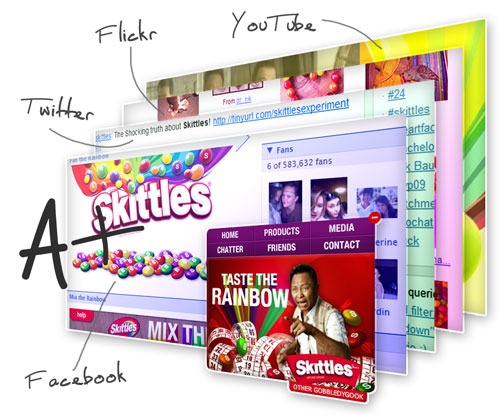
Skittles on Facebook, Twitter, Flickr, YouTube
Years from now, people will look back to the day Skittles ditched its flashy site and chose to load the top social websites that talk about it instead.
I can’t even begin to fathom how brilliant a campaign this is (despite being pioneered by Modernista exactly a year before). Maybe it’s not. I don’t know whether it’s so open-minded and fun, it doesn’t even look like a gimmick anymore or it’s just plain lazy to put the Skittles-related Twitter, Flickr, YouTube, Facebook, and even Wikipedia pages right on Skittles.com.
The cynical
Why load tweets, photos, or videos if you can just pull them via the the sites’ ever-useful APIs and create a page that’s sprinkled with 100% more colors and candy? (Come on, don’t deprive web designers and developers of their jobs!)
Is it even legal for a company to load another company’s web page to promote itself? (But asking that is like saying Facebook owns whatever you post on its site, and we all know how that turned out.)
Is seeing yourself on Skittles.com enough incentive to build buzz about the product instead of the marketers who will be handsomely rewarded anyway? (A resounding yes if you’re one of those new media douchebags, but let’s get to that in a bit.)
Do these cynical questions even matter if you’re enjoying the experience anyway?
The self-absorbed
Skittles took a risk. Some other company would have been worried about the possibility of smack and smut polluting the streams.
It’s bound to happen anyway, if this campaign lasts long enough and the new media douchebags pounce on another pure phenomenon taking place. I think that’s what draws people to this experiment. It’s raw, unfiltered, and free from any sinister intentions. (At least to the naked eye.)
Remember when SEO hadn’t been invented? When Wikipedia was an unbiased reference? When Twitter was all about what you are doing right now? When your friends on Facebook didn’t have their own fan pages?
And what about the other side of that purity—the cold, hard, messy truth? Because it’s only a matter of time when Skittles, which is not just sweet, innocent, colorful candy, but also a huge corporation, rakes up some dirt in its dealings.
If there’s one thing to take away from all this is that if you’re a company and dreaming of pulling off something like this, it’s not about you. (Or maybe it is, but can you at least try to make it look like it isn’t?)
Any publicity is good publicity, order will emerge from chaos, and worry less about projecting a reality distortion field, focus more on making your product great, because it will speak for itself.
A “website designed by…” link is like a Louis Vuitton monogram. It’s your brand. Let your clients wear it on their websites as proudly they would with a designer handbag.
Is this always true? What makes this practice highly recommended or downright tacky?
It depends. It always does.

Your brand should never hurt your creations, it should enhance them
I bumped into this post: You Will Never See “Designed by Atrick Design”. I totally respect everything he wrote there. And I am not going to say I am completely against it. In fact, I have avoided placing links, logos, and attribution for things I’ve done in the past. But some things struck me.
In Pat Dryburgh’s post, he points this out:
I will never let a “designed by” link do my marketing. I wouldn’t want to take that away from my clients.
A link does not have to be your only way of marketing. You can always do it at the same time you’re promoting yourself in the real world.
But what does that link take away from your clients? Why does does this awful perception exist? If you’re a good designer, (1) you will find a way to place your link so that it fits nicely into the design; and (2) visitors will consider it either convenient or eye candy.
more


I have nothing against premium blog themes, being custom designs that costs money to use, but not being unique. In other words, you buy a theme (and hopefully get support on it), and others can buy it as well. While you won’t get a custom design, you know that the theme in question won’t be as widespread as, say, Cutline, or any other popular WordPress theme. At the price of a license, ranging from $20 or so, up to a few hundred dollars sometimes.
People doing premium themes sometimes go to great lengths to defend themselves. Like Darren Hoyt did just recently, in a progress report on his upcoming Mimbo Pro premium theme. He said this, taking about the need for premium themes:
So there does seem to be a viable market since not everyone can afford a $10,000 custom design with a full-featured CMS.
Whoa there! $10,000 is a crazy number to wave around, when talking about blog designs! Darren probably knows that as well, since he’s throwing “full-featured CMS” in there, when he’s actually talking about premium themes in general, and WordPress ones in particular. more