IE6 falls; XHTML2 cancelled.
In yet another interesting turn of events, two of the biggest issues when it comes to web design and development make way for the newer, better versions of themselves.
Goodbye, IE6!
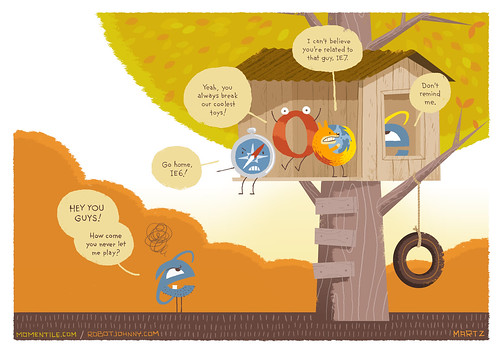
Asa Dotzler of Mozilla reports that IE6 usage has now been overtaken by IE8, based on the browser tracking data from Net Applications. This happened as recently as June 2009.
Of course, specific demographics on your respective websites will vary, but this trend is a sign of things to come. And we’re not talking about years anymore, but months.
I’d have to commend Internet Explorer team on their great marketing efforts to improve the IE8 adoption rate. Even if Microsoft’s latest browser is up to snuff compared to the likes of Firefox, WebKit (Safari/Chrome), and Opera—see these comparison charts for HTML5—it’s a big step.
This is it, guys. Freedom.
Goodbye, XHTML2!
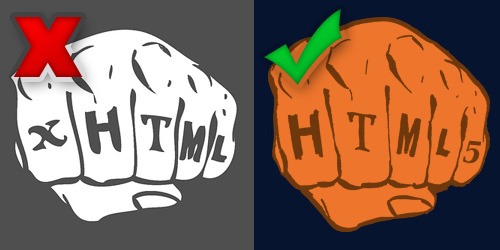
Slashdot reports that the XHTML2 Working Group charter is expiring by the end of 2009, and it will not be renewed. The W3C has also decided to pour more resources into the HTML5 working group.
Those who weren’t paying attention to this seeming sibling rivalry between XHTML2 and HTML5 can now rest easy. Though I’m not sure if XHTML2 ever stood a chance given how all the web gurus were backing HTML5 as early as last year. Google is on board, too. And everybody else is starting cash in on its growing popularity.
The good thing about XTHML was that it enforced well-formed markup, with strict provisions for lowercase code, quoted attributes, and trailing slashes for empty elements. Thankfully HTML5 this coding convention too, and can be served as a serialized XML document dubbed XHTML5.
At least we wouldn’t be forced to choose between the two anymore. Competition is good, but not here. We need standards.
Unwanted competition eliminated
How convenient is it that we have two less things to worry about now? Very, but now that they’re gone, it’s time to make up for lost time:
- Microformats. (This is the easiest to jump into.)
- Fluid layouts.
@font-faceand custom web fonts: this time it’s not just the browser makers that web designers and developers are up against, but the type foundries. TypeKit and Kernest are attempting to bridge that gap.- CSS nested declarations, variables, and operations: LESS
- CSS if statements: Modernizr
- Animated PNGs.
Exciting times, people!


IE8 has overtaken IE6, but IE8 adopters are coming from IE7, not IE6. The actual decline of IE6 continues at the same slow steady pace.
By lktree on July 7, 2009 1:37 am
IE6 falls; XHTML2 cancelled….
In yet another interesting turn of events, two of the biggest issues when it comes to web design and development make way for the newer, better versions of themselves….
By CSS Brigit | IE6 falls; XHTML2 cancelled. on July 7, 2009 7:50 pm
Tough I agree there should be some extensions to CSS, the more I use authoring tools, the less extensions I need.
For instance if the nesting of rules could be achieved with an authoring tool, why would we need it in CSS?
The same goes for variables and if statements.
More over — why would you need an if statement for functionality? It is either supported or not — you write the rules and they degrade when they are not supported. Simple as that ;)
I would appreciate some referencing like position “relative-to” or something like that, which is now possible only with JS.
And before LESS there was SASS, and frankly, it’s much much better, not to mention COMPASS Style (based on SASS) makes a statement what a CSS framework should be about. It has it all — variables, mixins, includes, trimming empty selectors, operations, loops, if’s.
– Ivan
By Ivan Zhekov on July 7, 2009 10:49 pm
I run a website for the US government. We get about 12k visits a week. Last week, we had 4 times as many IE6 users as IE8. So from my perspective, we have a long, long way to go.
By Sean on July 8, 2009 1:50 am
I agree with lktree, nothing about that graph indicated the fall of IE6 (thought I’ll admit I might have shouting of it’s demise from the rooftops for more than a second out of shear hope).
I think by this time next year IE6 will be below 5% which is what I’ve decided my threshold will be. Here’s hoping.
I am excited for the decision to discontinue xhtml, great though it may have been. I agree, standards are what we need.
By Josh Hudnall on July 8, 2009 5:40 am
http://www.w3schools.com/browsers/browsers_stats.asp
http://www.w3counter.com/globalstats.php
http://www.thecounter.com/stats/2009/June/browser.php
As far as I can see, IE8 is still far from IE6.
By Cristiano Rastelli on July 8, 2009 6:10 am
[...] The Internet Explore marketing team are aggressively pushing IE 8 into the browser war. They know themselves, IE 6 is no longer fit for modern web. Goodbye IE 6. [...]
By Goodbye IE 6, 6 Reasons It Must Die | Noktah Hitam on July 8, 2009 1:39 pm
[...] we’re now in this transitional stage of shedding off old browsers and web technologies that have been stumbling blocks to creating innovative new [...]
By Clarifications on XHTML & HTML5 | Wisdump on July 16, 2009 1:53 am
ie6 is a deep pain in the ass.
should i drop ie6 compatibility?
T_T
By xun on July 17, 2009 5:48 pm
[...] “Exciting times, people!” wird in der Developer-Community die aktuelle Entwicklung der Webstandards und die Abkehr [...]
By XHTML: Tod eines Schaustellers - css-petals.net - beautify the web on November 13, 2009 1:30 am