The Ebb and Flow of Social Networking
I joined Facebook today. I resisted as long as I could.
I couldn’t help but notice a recent surge of other people I know signing up recently as well – nor could I shake off the odd sense of déjà vu. It seems like such a short time ago that MySpace was the place to be in terms of social networking – now it seems that’s all over and Facebook is now the ‘site du jour’.
It’s not the first time something like this has happened, either – there have been countless communities online that have grown, peaked, and slowly faded into obscurity. Like a roving band of wildebeest, it seems communities arrive en masse, graze for a while, and move on to pastures anew.
The current crop of Web 2.0 sites seem to have amplified this trend – there are more and more sites cropping up with a community angle, so now people hungry for social interaction on the web have a near boundless choice for their communal appetites.
As surely as Facebook has risen to challenge MySpace, and as Digg has all but displaced Slashdot, in the not-too distant future there will be other sites which rise to threaten the current generation. Perhaps the MySpace killer is already out there, just waiting for a chance to break the mainstream?
Modelling Social Network Communities Growth
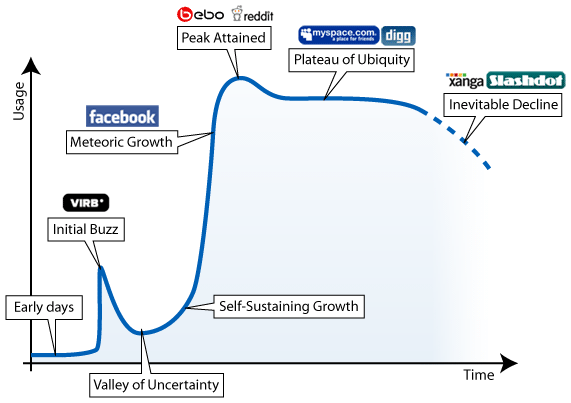
The early days of a community site are its most fragile -most start-ups will fail without ever making it past this phase. Those familiar with running forums or sites with a community aspect will know how hard it is to get a sustained level of activity without a solid user base – avoiding the tumbleweed can be difficult.
With work and persistence some sites will begin to make headway – a small, closely-knit community can develop. Many community sites will persist at this level, with no real reason to change – others may get lucky and find a break – whether it’s a link from a major blog (TechCrunch or similar), getting on the front page of Digg (or Reddit, Netscape, etc), or even a news report or feature in the mainstream media.
Such buzz can cause a massive spike in traffic – propelling the previously unheard-of site into the view of thousands more people, and potentially kick-starting a chain reaction large enough to push into the mainstream. Of course, there are no guarantees – a spike in interest from a single link can come and go very quickly, with little net benefit.
The social networking site Virb has had its fair share of buzz – it’s been on Digg, been featured on a few high-profile blogs, but has a fairly modest Alexa ranking of around 5,000 (at the time of writing). It’s firmly in the ‘crunch’ phase of start-up sites – the ‘Valley of Uncertainty‘.
For Virb, there are two possible paths – the first is unfettered and gradually accelerating growth, the other is to remain in the doldrums indefinitely. With such a great deal of competition in the social networking sphere, it could go either way.
Facebook is the perfect example for a site currently in the midst of meteoric growth – from an Alexa ranking of around 50,000 in 2005 to around 100 in 2006, to 18 today in 2007. Little wonder that people are eager to acquire the site – even at a stupidly high price.
Such rapid growth is unsustainable, of course – and ultimately such popularity will reach a peak. There are but a finite number of people to populate any given social network, and humans are notably fickle creatures. Ultimately the usage levels for any given site will stabilise – social networking site Bebo and social news site Reddit are both in neutral-growth periods – not to say that future growth is impossible, but without intervention the user base is unlikely to spontaneously increase.
For the top few sites that attain popular appeal, a healthy period of traffic and utilisation follows the peak in usage – established services such as Flickr, MySpace and Digg have such sustained appeal that they persist at a relatively stable level – the ‘Plateau of Ubiquity‘, if you please. How long a site persists here depends on several factors, principally including the fierceness of competition and the rate at which a site can evolve to keep its users happy.
The internet is a fast changing place, and to hold a position of dominance with so many fresh upstarts is not easy. While a community site can revitalise, innovate and hence prompt additional growth, life at the top is tough. For many once-reigning sites a slow yet inexorable decline is inevitable. The once mighty Slashdot is still very popular – it’s in the Alexa Top 500 – but slipping further and further away from the pole position it once held, with younger upstart Digg usurping its audience.
Social networking and community-led sites dominate the top ranked sites on Alexa, second only to the search engine contingent. With such massive reach and the potential for direct marketing, it’s not in the least surprising that the top of such sites are seeing such lucrative buyouts – $580m for MySpace, $1.65b for YouTube, and a touted $1b for Facebook. I don’t doubt that some of these acquisitions are worth it – the potential to reach people directly on the sites where they spend most of their time is valuable indeed.
I guess I’ll see you all on Facebook. For now, at least.
Stuart Brown is a web professional and analytically-minded blogger at Modern Life.
If you are selling products online then you need a credit card processing because mostly people use credit cards for online shopping these processor works on software based technology which are offered by companies who also provide web hosting for your site and internet marketing services along with the affiliate marketing which is best for your site, these companies have their won web servers, so some of them provide internet phone services of best quality.


[...] Wisdump has has article called The Ebb and Flow of Social Networking which discusses the common life cycle of a social networking website, from the early days to the initial hype, rise and eventual decline, with examples of sites currently at each stage. It’s an interesting read. [...]
By Tech Center Current » Blog Archive » The Ebb and Flow of Social Networking on June 3, 2007 9:53 am
I think you have a point here, but is it really that different from any other industry? The “product lifte-cycle” is studied in most marketing/management courses — it ends with a maturity stage, then decline/death. Entire industries often have a similar lifecycle (think VCRs, or even stage coaches).
By Mike Malone on June 3, 2007 10:11 am
Mike – Very true, but what’s remarkable is just how quickly such networks come and go. There’s been several generations of online communities & social sites in the last 10 years – ranging from archaic BBS networks, through Usenet, forums, and the current batch of socially-led sites.
Even with technologies such as VHS / DVD / HD-DVD you’ve got a product lifecycle of years, possibly decades – compare this to the short years and months of a popular online community.
By Stuart on June 3, 2007 1:42 pm
[...] Stuart Brown, author of Modern Life, has written a great article on The Ebb and Flow of Social Networking. [...]
By The Ebb and Flow of Social Networking - Tyler Reed on June 3, 2007 1:47 pm
[...] Update: Would usually del.icio.us this, but it is quite salient to this post, so: Wisdump: The Ebb and Flow of Social Networking. [...]
By doctorvee » ...Other social networks are dead (part 2 of 2) on June 3, 2007 1:53 pm
To further illustrate your point, where’s Friendster? or Second Life?
Some of the cycle is accelerated by press coverage. You get an artificial spike of signups and attention, everyone creates an account, and after two weeks, three-quarters of them don’t come back.
But the real issue is that sites that focus on young users looking for the next trend are mostly bound to be abandoned at the same pace. You joined Facebook in a swell along with your friends; you’ll all move onto the next club in 6 months (or 12, or 3) when something more up to date comes along.
By Diana Wynne on June 3, 2007 2:23 pm
A cursory glance at the Alexa data for Friendster (http://www.alexa.com/data/details/traffic_details?q=&url=www.friendster.com) would indicate it’s approaching, or has just reached, a peak.
Second Life is a little more difficult to gauge, but the traffic seems relatively steady, which could indicate either a plateau in usage or a slow but healthy increase.
I do hope Facebook sticks around for a while – I’m getting sick of registering for sites like these! :-)
By Stuart Brown on June 3, 2007 2:45 pm
[...] On a long enough timeline, the survival rate for every social network drops to zero. (via Wisdump) [...]
By On a long enough timeline ... - Adam Howell dot org on June 3, 2007 11:32 pm
What would really be interesting to see if possible is where the people go when leaving a site. Another interesting thing to notice is how sites react to each phase they are in. It seems Digg is aware of the stagnation/decline and because of this announced they will do product reviews, which I’m not too sure will work well with their community. Sometimes you are so locked in with what you do there is no way out.
Of course if you are Myspace/Bebo/Facebook and have millions of users it is hard to always expect an upward climb as there are only so many people on the web and only so many that care about sites such as those.
By Scrivs on June 4, 2007 3:34 am
One of our cast members started a group at Facebook about a week and a half ago. At first I was hesitant to sign up myself, but within a few days Facebook was sending us 100+ visitors a day. I had to see what it was all about.
As it turns out the Globe Roamer TV group has just under 300 members and it has only been a week since it was launched.
It’s obvious Facebook is becoming more and more active. More so than I think most of us realize.
By Eric on June 4, 2007 3:48 am
The entier premise of this is just stupid. MySpace is “over”? So how come it is growing by far more users every day than Facebook?
By JKFan on June 4, 2007 3:59 am
[...] The Ebb and Flow of Social Networking Filed under: Uncategorized — recar @ 8:04 am The Ebb and Flow of Social Networking “As surely as Facebook has risen to challenge MySpace, and as Digg has all but displaced Slashdot, in the not-too distant future there will be other sites which rise to threaten the current generation.”[industry news] [technology] [news] [...]
By The Ebb and Flow of Social Networking « News Coctail on June 4, 2007 4:04 am
[...] read more | digg story [...]
By The Ebb and Flow of Social Networking on June 4, 2007 4:28 am
@JKFan – Two questions. At what point did I state that MySpace was ‘over’, and what’s your source on those growth figures?
By Stuart Brown on June 4, 2007 4:29 am
[...] Muy interesante el artículo que se publica en Wisdump acerca del ciclo de vida de las aplicaciones web basadas en redes sociales, tan famosas hoy en día. [...]
By La curva de evolución de las redes sociales on June 4, 2007 5:01 am
Interesting to see that Second Life is mentioned in the comments but not on the main article; in fact, although the website for http://secondlife.com does not have anything to do with the actual usage of the platform (since it is not web-based and thus escapes Alexa’s ranking), the site supporting the creation of a Second Life account has been steadily hovering around #1500 for at least half a year now. Even if tt doesn’t directly reflect actual usage of Second Life; nevertheless, it’s still interesting to reckon as at least a 6-month-long plateaux. If it’s on the “Uncertainty Valley” or the “ubiquous” stage, it’s hard to know; the visionaries and optimists would certainly claim it’s still on the valley yet…
So, and what happened to Ringo, Friendster, Orkut (the latter is still #8 on Alexa…)?
By Gwyneth Llewelyn on June 4, 2007 5:38 am
this is retarded – everything gets replaced after a while. ebb and flow of social networking? you sound like one of those ‘digg’ losers and you probably are
By max on June 4, 2007 6:00 am
The article makes a good observation but I feel it should have went further. This is interesting for any startup as understanding how your business will grow and develop is critical to any success.
As has been pointed out Digg seems to be the obvious one that have realised there is this trend and are trying to do something about it, by essentially adding in more features which would hopefully get them another spike in new users.
Too many sites assume because they were succesful once, and have 500,000 visitors they will continue with that traffic. People are too fickle for that and if content and features arn’t being added people will slowly stop returning.
By Col on June 4, 2007 6:22 am
what you have done here is just rehashed G Moore’s Crossing The Chasm theory .
By Prashant on June 4, 2007 6:33 am
interesting article.
By Psychic readings on June 4, 2007 6:56 am
social sites depend on dynamic periodic updates to remain ‘fresh’ to the user. people get sick of the same site, so they try new ones… like I am getting sick of myspace, so I am trying facebook out. without frequent overhauls of the look and feel of a site, it is bound to level off in user base and will eventually decline as competitor sites develop strategies to compete.
By the constant skeptic on June 4, 2007 7:07 am
[...] The Ebb and Flow of Social Networking [...]
By Charles Gray » Links on June 4, 2007 7:28 am
I think you all have some very interesting points, however I believe that only when these sites generate some real value to its users will the sites stick around. Customers will soon get fed up with registering all the time and moving their content.
By Chris on June 4, 2007 7:30 am
There can be only one. Trig.com :)
By Love on June 4, 2007 8:01 am
the problem is finding away to make your site sticky. face has features that will bring you back everyday but will that be enough. something nobody every talks about is the voyeurism factor. everytime a social networking site allows people to see who looks at their profile they combust. that was the final nail in friendster’s coffin.
http://www.buythatlocally.com
By gordon on June 4, 2007 8:22 am
Suggesting that SlashDot is on the decline is absurd. Particularly, the suggestion that Digg of all sites has replaced ShashDot. The readers of SlashDot are second to none in terms of collective knowledge and the forums of SlashDot are far richer, better written, and contain more knowledge than Digg.
Secondly quantity is not necessarily better than quality. Slashdot chooses a good set of articles and does not try to inundate users with sites, which is the allure Digg.
Finally, one level of discussions? How can one have any conversations with just one level?
By Saif on June 4, 2007 9:38 am
The Ebb and Flow of Social Networking…
This story has been submitted to Stirrdup. If it can generate enough interest, it will make it to the main page….
By Stirrdup on June 4, 2007 9:45 am
So things start off unpopular, might or might not get popular, probably stay popular for a while unless they don’t?
nice one
http://www.josemousetrap.blogspot.com/
By jp on June 4, 2007 11:07 am
@jp – That’s a bit of a glib meta-analysis, but I suppose you’re correct. There is much commonality between those sites which do attain success, however.
By Stuart Brown on June 4, 2007 11:18 am
This is why I’ve always been amazed at the huge ($1billion+) web buyouts – in a way it’s like trying to bottle lightning. Huge sites today are gone tomorrow, so what are you left with for your money?
Shameless plug: I like to think that Blored.com is in the “Early days” and building up to the “Initial Buzz” :p
By Alex on June 4, 2007 11:21 am
I personally Like Facebook compared to myspace now it’s simple , no need to code anything. it’s more human . the audience is more mature.
By Jeff on June 4, 2007 1:07 pm
This isn’t really surprising. All ‘trends’ have a rise and fall of some kind. In fact, everything does. It’s just the way things are.
And about ‘bottled lightning’, by the time these websites are ‘gone tomorrow’, the money will have been made and all goals accomplished. They’re not dissapearning that quickly, and in the meantime, a lot of money is being made.
By Freelance Website Design on June 4, 2007 1:08 pm
[...] “As surely as Facebook has risen to challenge MySpace, and as Digg has all but displaced Slashdot, in the not-too distant future there will be other sites which rise to threaten the current generation.”read more | digg story [...]
By ah! » The Ebb and Flow of Social Networking on June 4, 2007 2:48 pm
I wonder if Facebook could truly become a “utility”? That IS their plan as Mark Zuck has repeatedly stated.
Could it become the E-mail of the next generation?
Stuart, I’d love to hear your thoughts on this.
By On the Fence on June 4, 2007 3:15 pm
[...] A nice post on Social Networking sites over here at wisdump, it does however make some assumptions that largely the same groups of users float from one networking site to the next leaving the others behind for dead. This may be true in some cases, but it doesn’t take account of the increasingly large number of broadband connected always on users and the increasing uptake of web communication as the de facto way of keeping in touch. True there are a finite number of users, so super rapid growth can’t be sustained in the long term, however this doesnt also equate to an equally speedy up and leave mentality. I think we’re still way way off the peak of adoption in social networking sites, and there are countless scores more to emerge and challenge for a place among the frontrunners. [...]
By Naked Imagination » Blog Archive » Facebook, the next Generation Portal platform? on June 4, 2007 3:51 pm
My social networking web site for poetry, Love Across Borders, is also riding the current wave of the tide right now.
Love Across Borders Community Publishing
http://www.loveacrossborders.com
By Shaun Apple on June 4, 2007 4:06 pm
I don’t think there will be single killer. I think the answer lies in the mobile and network profile manager.
I think whoever achieves a ubiquitous profile manager that is achieved through a mobile interface first will be the leveler rather than a killer!
By Social Squad on June 4, 2007 5:24 pm
The figures of all these ‘social networking’ sites are hugely overblown (aside: if people spend so much time on these sites that they neglect their real friends and family are they not _anti-social_ sites?).
I’m not suggesting they are lying, just that there is a period of buzz during which people visit the site, find something they wish to see (no matter how transitory that interest might be) and have to sign up to get at it. Hey! Another convert joined in! This is particularly prevalent in the earlier stages where the number of potential mugs, sorry – believers, is greater than the volume of people who have been there, done that, never again.
I am bored with the number of permutations of my name and numbers I have to try in order to sign up to Yahoo or any other such site – all the other versions are probably mine too but I can no longer remember the password I made up on the spot to see something on a whim, nor the fake birthday I used as part of my security question (why would I want to use my real one?). Of course I could use the same password I always use (“chocolate”, for anyone that cares) but I’m not Tracy in Marketing so I tend not to be that casual with my security. So, I have contributed between 3 and 5 members to several sites just to see Flickr photos of my friends’ weddings or MySpace pictures posted by someone who at least seems to have enough taste not to have a gaudily coloured, repeated background picture which strains my eyes and brain in equal measure.
No wonder they claim millions of members – but I wonder how many return visits they get per member…
By AdamV on June 4, 2007 5:37 pm
[...] When did you do your first google search? I wish I knew. As the internet gets older we’re going to look back on it more. Since I send such a crazy amount of time online I look back and try and see where I fit in the history of the web. This great post at Wisdump about the The Ebb and Flow of Social Networking really got me thinking about where I fit in the flow. [...]
By Stefan Hayden » Blog Archive » Social Network Registration Dates on June 4, 2007 7:04 pm
[...] The Ebb and Flow of Social Networking Great graphic of where different sites are in terms of usage. (tags: web2.0 socialnetworking facebook social trends) No comments [...]
By Anne 2.1 » 2007 » June on June 4, 2007 7:31 pm
See you on facebook!
Great article and graph, i think xanga will never represent that much however, it just looks to be growing.
By Americo on June 4, 2007 8:30 pm
Great post! i think this is an interesting trend in web 2.0 sites. But I think the bigger question should be, how long will this trend last. Great case study (not sure if i should be using that term ;).
By Jonathan Solichin on June 4, 2007 8:45 pm
I’m not convinced this is universally true – I think it is true in a niche. We need to draw a distinction between social networking sites, professional networking sites and platforms (such as second life). The demographics and behaviours of each are very different.
I refer you to a survey I did recently:
http://blog.beaufortes.com/2007/05/networking_proj.html
It turns out that LinkedIn has managed to sustain its dominance over a very long period of time (in InterWeb terms)in the professional networking space – even though many of the qualitative responses I got indicated their main success from the site was re-establishing personal connections.
By Philip Greenwood on June 5, 2007 5:10 am
[...] The internet is a fast changing place, and to hold a position of dominance with so many fresh upstarts is not easy. While a community site can revitalise, innovate and hence prompt additional growth, life at the top is tough. For many once-reigning sites a slow yet inexorable decline is inevitable. [...]
By Social networking’s rise and fall | THE blog on June 5, 2007 7:45 am
[...] The Ebb and Flow of Social Networking [...]
By Max Design - standards based web design, development and training » Some links for light reading (5/6/07) on June 5, 2007 10:19 am
Great post. What I’d like to research a bit more is what the impact of hitting the plateau at a lower usage level is. In other words, is there a drawback to creating a major frenzy and having no place to go but down? (becoming flash in the pan) Perhaps there’s more to learn from the social networks that don’t reach the huge critical mass, but instead settle in among a more focused and sustainable constituency.
By Scott on June 5, 2007 11:10 am
[...] This morning I found an excellent post at wisdump that concurs with what I’m seeing. It’s not the first time something like this has happened, either – there have been countless communities online that have grown, peaked, and slowly faded into obscurity. Like a roving band of wildebeest, it seems communities arrive en masse, graze for a while, and move on to pastures anew. [...]
By Captain’s (b)Log » Blog Archive » Facebook makes some noise on June 6, 2007 9:21 am
[...] Modelling Social Network Communities Growth, Wisdump [...]
By Andy Howard | Digital Strategy and Website Production | The Tool Comes Before the Network on June 6, 2007 10:09 am
[...] Compare Andreessen’s optimism, which includes an exploration of the role of pessimism in survival, to blogger Stuart Brown’s demonstration of the social network’s life cycle. Brown charts "the ebb and flow": the flat early days, the buzz, the growth, the peak, the plateau, and the inevitable decline into obscurity. [...]
By You’re Getting Older, And So Are Social Networks - Internet Insider Report on June 6, 2007 2:47 pm
I joined Facebook today too, on personal recommendation, and partly as I cannot stand another eye-straining, web design-train wreck MySpace layout, despite it’s single over-riding plus – it’s weight of community numbers.
But my fingers tire of typing my name, email and thinking up a new variant password to sign-up to the next big thing.
Not that I’ve signed up to many social networking communities, I’ve deliberately been selective, partly because there are only so many hours in the day to check/update my entry/profile, but partly because you have to consider the value of each network.
Like when it mattered how many of your friends had the same mobile provider, now it matters how many of your friends are part of the latest social network community or the realistic benefit of being part of that network.
By Richard Kendall on June 6, 2007 7:32 pm
I like this post a lot and I need to pay attention to this site again.
This is a little side ranting (it will be short) but, why are people above social networks? “I joined Facebook today. I resisted as long as I could.” Why did you resist?
I understand that there are people out there, who take them to limit. Devote their lives to getting comments on their photos etc. Just use it responsibly, you don’t have to feel dirty for joining.
Great post keep it up, can we get some author credits next to the posts? Or are you trying to keep the focus on Wisdump?
By Ellsworth on June 7, 2007 10:20 am
@Ellsworth – It’s not so much a resistance to social networks, but a resistance to signing up to new ones after investing time in perfecting one’s profile on another site :-)
Btw, there’s a byline at the bottom of the post. With the coming redesign I imagine it may be more integrated.
By Stuart Brown on June 7, 2007 10:34 am
Hey man. I noticed your site and I’ve been thinking the same paranoid thoughts. In fact, I started a facebook group dedicated to it. It’s called Facial Deconstruction (South African network)
The idea is to get a bunch of university philosophy and theory students together to discuss how and why things like facebook and myspace happen. To deconstruct facebook from within itself. So far, response has been slow. It turns out that no matter how intelligent people are, their brains switch off when they go on Facebook. Even I haven’t managed to post anything useful. I would appreciate it if anyone just went and had a look.
I thought it might be an interesting project. My idea was to gather a whole lot of relevant posts, sift out the rubbish, edit it and possibly publish it as an ebook. No real profits or anything, just an interesting thing to do.
Leave a message on the group wall if you would like to join.
By Chase Richards on June 7, 2007 6:04 pm
[...] An interesting artikel on the life cycle of social network communities on wisdump.com. [...]
By For Users Only » Blog Archive » The eb and flow of social networking on June 8, 2007 6:02 am
[...] Het punt is bereikt dat mensen gaan overstappen van MySpace naar Facebook. En dat kan een sneeuwbal-effect hebben, zoals in het tweede plaatje te zien is. [...]
By » Twitter, Jaiku of Numpa? - 08-06-2007 - Content Cantina on June 8, 2007 9:01 am
Mike, yes this is very true. But an interesting point to make is how can a social networking site stay popular. Surely if the website was to continuously evolve, improve and extend itself it would not fade out into obscurity. Alternatively, one could take the Google approach and just buy the competition.
By James Oppenheim on June 10, 2007 9:31 pm
[...] 4 – The Ebb and Flow of Social Networking talks about the growth of social networks [...]
By Here is your del.icio.us goodness for 06-14 - mattherzberger.com on June 14, 2007 4:23 am
[...] Perhaps it’s because online communities are perceived as rather ephemeral (think of the exoduses from Friendster to Myspace to Facebook [great article on that subject here]) that journalists and academics have steered clear of historical approaches to them. This would of course be the classic act of mistaking the medium for the content, because as anybody who participates in any of those social networking sites mentioned above knows, you tend to stick with many of the same people regardless of the site you’re on. Obviously, there are many fly-by-night guilds, and one-man guilds around, but many guilds have long and fascinating histories. [...]
By Another book about MMORPGs « Dark London on June 14, 2007 5:36 pm
Stuart Brown’s diagram is a direct ripoff of Gartner’s “hype cycle.” This has been in use since about 1998, and used to evaluate the maturity of emerging technologies. Gartner has five stages: technology trigger, peak of inflated expectations, trough of disillusionment, slope of enlightenment, and plateau of productivity. That he doesn’t attribute them for the inspiration is pretty poor. Ho hum. Also, one thing that rather pisses me off is the reliance on Alexa to determine how popular site are. Really – this is just bunk. Alexa’s rankings are based on data derived from myopic geeks running the Alexa toolbar in their browsers. They’re a sub-set of a subset of population. Basing any kind of judgement on what’s actually popular against those sorts of stats is just idiotic.
By Jonathan on June 15, 2007 5:22 pm
[...] Good article explaining the ebb and flow of social networks. [...]
By The Ebb and Flow of Social Networks at Metafluence on June 28, 2007 1:56 pm
[...] The Ebb and Flow of Social Networking is an insightful little observation for those of you (us) fixing to make hay with the social networking phenomena. (That site distorts the graph, see it clearly here). [...]
By Blog Mann » Happy Links on June 28, 2007 3:46 pm
[...] Luglio 2007 a 3:08 pm · Archiviato in social networks, marketing Stuart Brown su Wisdump divide il ciclo di vita di un social network in 7 fasi: Early days Initial buzz Self sustaining [...]
By Ciclo di vita di un social network « Marketing For Nerds on July 3, 2007 6:09 am
[...] and your whereabouts… These sites are popping like mushrooms and dying like flies – typical lifecycle of a trend. Last year it was Myspace and Digg, today everybody is on Facebook. I can bet that some Facebook [...]
By Why web 2.0? « On a web biz note… on July 3, 2007 6:21 am
I think all of your points are valid and reasonable, however there is another dynamic that was overlooked.
These social networking sites usually end up dominated by a certain sect, denomination or age range which will eventually alienate all but the most hardcore user. Then it’s time to move on. The original core group at Facebook has all but disappeared including me because the focus has shifted. Eventually the new hot thing will come along and I’ll jump in until it gets polluted then I’m gone.
By homer on July 4, 2007 8:47 am
I feel sorry for people who havent got the strength of mind to create a web presence for themselves without using all these community sites. Its just a herd instinct, and the graph shown in the article doesn’t surprise me in the slightest. People are so fickle, they jump from one bandwagon to another because they’re afraid of missing out on something. Often a trait of the younger set, which is where I don’t belong these days.
I suppose, if their offline lives are so boring, then they need an Internet social networking community to give them a sense of identity. To my mind its just a big gossip circle. There are business opportunities to be had with it, if you work with it effectively, but the constant rise and fall to/from stardom makes it rather unreliable.
I have a website and only recently decided to do a blog, but quite honestly I could manage well enough without the second item.
By Chris on July 6, 2007 7:42 am
[...] Social networking is happening all the time. The real question, then, isn’t whether you’re engaged in social networking. Rather the question is are you taking full advantage of the social networking you’re already doing? [...]
By Understanding How Social Networking Works - Dawud Miracle @ dmiracle.com - (formerly Healthy WebDesign) on July 6, 2007 8:41 am
[...] The Ebb and Flow of Social Networking there have been countless communities online that have grown, peaked, and slowly faded into obscurity. Like a roving band of wildebeest, it seems communities arrive en masse, graze for a while, and move on to pastures anew. (tags: community onlineculture history youthculture socialnetworking socialnetworks facebook myspace) [...]
By links for 2007-07-06 on July 6, 2007 4:31 pm
[...] The Ebb and Flow of Social Networking [...]
By (EMP) E-Marketing Performance » : » Team Reading List 7.9.07 on July 9, 2007 8:14 am
[...] blog about social networking is interesting. It discusses the ebb and flow of social networking sites, including the evidence [...]
By libraries on social networking sites « Kelly’s Blog on July 11, 2007 6:22 am
[...] Steve Rubel pointed to an article from Stuart Brown at WisDump a couple of days ago that showcases the ever-shifting sands of the Internet. The article focuses on Web 2.0 and Social Networking sites, but it really applies to the Net as a whole. Success in the Sphere of Popularity means that you need to have a finger on the pulse of the Internet. [...]
By Valentin Yeo » Blog Archive » Musing on the shifting sands of the Net on July 13, 2007 1:25 pm
[...] to social networking is interesting. Another article I read recently talked about the “ebb and flow of social networks” which made me wonder why this actually happened, what or who drives users to a new social [...]
By Part.1: Swarm theory and Social Networks « Digigen on July 19, 2007 2:38 am
[...] The Ebb and Flow of Social Networking [...]
By Highly useful web development resources that you’ll want to cntrl p at Metafluence on July 31, 2007 10:14 am